
Even under the prevailing industry challenges of labour constraints and construction cost escalations that are creating a feasibility crunch on most projects, they are sticking to their visions to move cities, towns and suburbs forward.
Not afraid to break the mould, these developers push the boundaries of built form design and innovative placemaking across development sites big and small.
Working with equally visionary architects, designers, builders, funders, councils and communities they are leading the way with pipelines of projects focused on making new things happen in the development realm.
As the co-founder of tech giant Apple, the late Steve Jobs, once said: “Those people who are crazy enough to think they can change the world are the ones that actually do”.
Here is The Urban Developer’s curated list of Australia’s Developers to Watch in 2024.
JD Property Group
Byron Bay, NSW
Jason Dunn is a Byron Bay-born and bred developer.
That somewhat diametrically opposed job description is by no means lost on him.
But it also is the foundation for a unique perspective and local understanding that has been the foundation for his success in the northern NSW coastal town that has a reputation for being—as he puts it—“super protective about what makes it special”.
“You really can’t be a part of the community here if you’re not listening to the community,” Dunn says. “So community consultation is where we sort of start all our projects.”
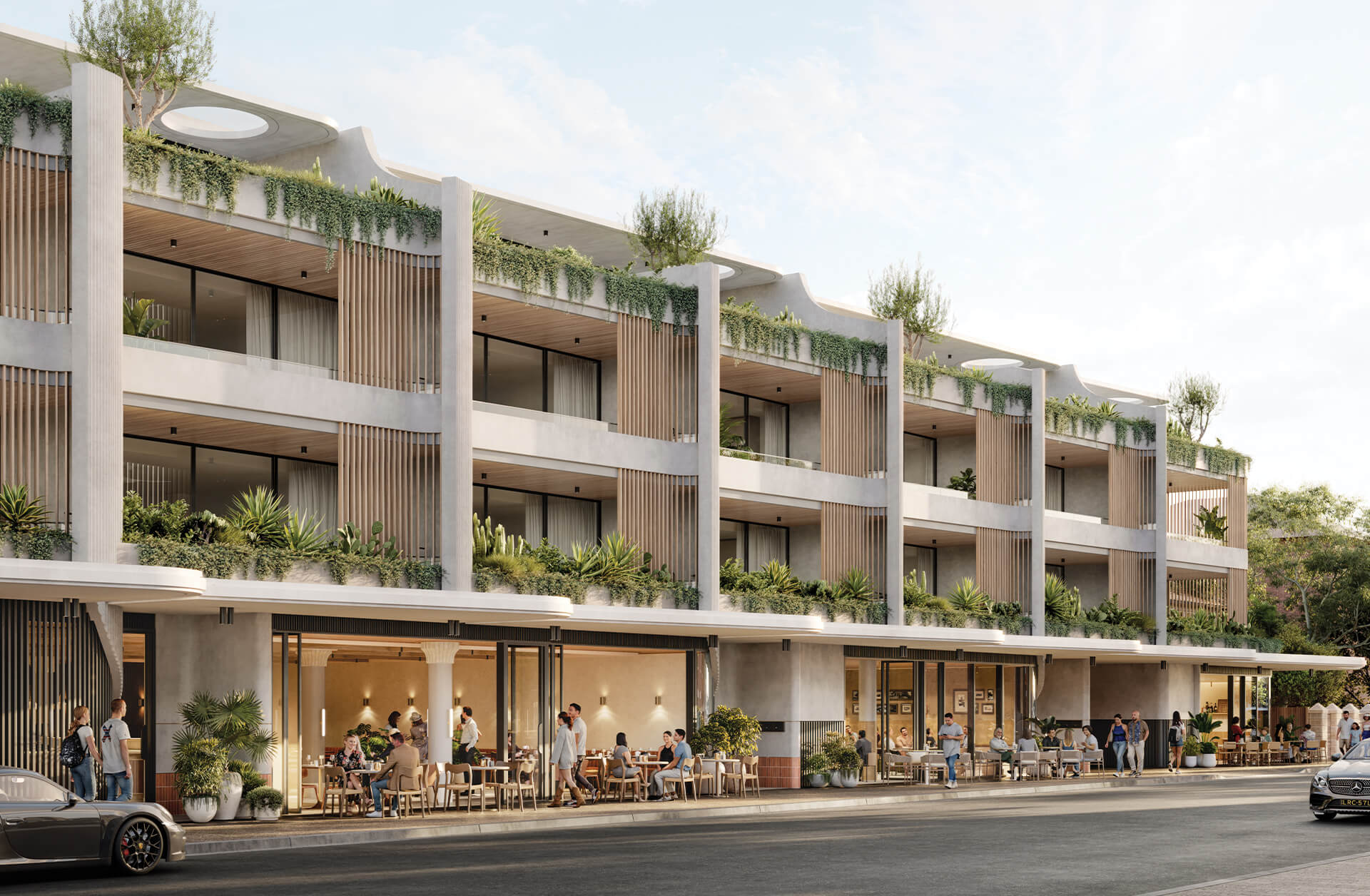
After a career seachange from being an investment banker, Dunn is now progressing plans for his second boutique Byron development, The Secret Garden—a three-storey shoptop scheme designed by Melbourne-based Bayley Ward Architecture.
The proposal fronting Jonson Street comprises 22 apartments and ground-floor commercial space surrounding an existing melaleuca tree.
It follows JD Property Group’s nearby award-winning low-rise Jonson Lane mixed-use project.
“In Byron, we’re sort of at the forefront here with political activism and really making sure that people are hearing that we want the world to change,” Dunn says.
“You can’t be born and bred here without that washing over you.
“And we’re trying to add that into our buildings … the big thing for us is sustainable design. The natural environment here really defines our projects.
“When you live in such a beautiful part of the world I think you’re really influenced by what’s around you.”
Dunn has his foot on other sites around Byron and in the not-too-distant future is looking to expand his development horizons.
“We’ve definitely got our eyes on other asset classes, such as hotels.” But, for now at least, he says he is sticking to luxury, mixed-use residential-led projects that “showcase the best that Byron has to offer”.
Graya
Brisbane, Qld
Brothers Rob and Andrew Gray have come a long way from their famed transformation of a dilapidated hoarder house in Brisbane’s inner-city Paddington.
But with Graya’s evolution into high-end boutique multi-residential developments, that unique approach to each project remains and is integral to their brand.
“Our product is extremely different,” Rob says. “It definitely stands out from anyone elses.
“We’re young … a lot of the other developers in the luxury multi-res space are traditionally 10 or 20 years older than us and they’re taking a lot less risks from a design point of view to deliver their buildings as cost effectively as possible.
“Whereas, we’re keen to leave our mark and we’re willing to spend the money to always deliver something unique to the market.”
He cites Graya’s green-covered facades, details such as “funky precast concrete” and pushing the envelope with “as big apartments as possible”.
“What a lot of experienced developers thought were risks have only turned into a reward for us.”
In March last year, Graya secured the highest price paid for a non-riverfront apartment ($3.5 million) at their recently-completed Canvas Bulimba project in Brisbane’s inner-east.
Among its current $300-million workbook of five projects under construction and three in the pipeline, Graya has recently broken ground on its Gold Coast debut.
Kloud is one of two greenlit boutique residential towers it is developing along the exclusive oceanfront Jefferson Lane at Palm Beach. Together with Ripple, the projects will deliver more than 40 luxury apartments.
Back in the company’s Brisbane stomping ground, construction is under way on its Chalk and York developments—comprising10 and 5 apartments, respectively— at inner-city New Farm, as well as its four-apartment Atria project at Toowong.
“And we have another riverfront Brisbane site that we’ll be announcing in coming weeks,” Rob says.
Clutch
Sydney, NSW
The Sydney eastern suburbs developer is already behind some of the city’s most sought-after luxury apartment developments but is far from resting on its laurels.
Clutch head of development Nick McCarthy says the company is constantly striving to take its projects to the next level.
“We try to push the envelope on our projects in planning and design,” he says.
As well, he adds: “We take a collaborative approach to our relationships with buyers, continually refining and enhancing our product based on their ever-changing design and lifestyle aspirations”.
Clutch has tapped into the pent-up demand in the eastern suburbs for large luxury apartments for downsizers and retirees.
“Our focus is to create apartments where they don’t have to compromise on the luxuries within their current houses,” McCarthy says.
Its pipeline for 2024 includes a development on one of the single largest mixed-use sites in the eastern suburbs at 135-155 Curlewis Street, Bondi. The plans comprise 15 three-bedroom apartments and three four-bedroom penthouses along with 1150sq m of retail space.
“We try to take an international approach to our developments,” McCarthy says. “In our project in Curlewis St we are looking to implement a full-time building concierge, which is seen in cities like New York and Los Angeles but is uncommon in Sydney.”
Design wise, he says, Clutch is also always looking to implement new features into its developments.
For example, in its Mira project at Bellevue Hill it incorporated a large round communal pool—a rare amenity for developments in the area.
The other boutique project on its books is at 440 Edgecliff Road, Edgecliff. Also designed by PBD Architects, it comprises four three-bedroom apartments and three penthouses.
“We believe we are making a difference in the industry by going above and beyond … and strive to improve with each project.”
Angle
Melbourne, Victoria
The Melbourne developer has honed its delivery of high-end residential projects with view to creating a lasting legacy.
“We have looked up to Neometro and Piccolo, who are pioneers of the development sector in Melbourne,” director Lachlan Gibson says.
“For decades, both of these groups have been at the forefront of design trends and have a genuine commitment to quality, two attributes to which we aspire.
“It would be nice to look back one day and feel that we have left a similar sort of legacy via our own projects.”
Angle’s projects to watch this year include the 20-residence Fernhurst, its second development in Studley Park in the city’s east.
It follows its Fenwick project, which cemented the developer’s reputation just down the road. Again, it has partnered with design studio Edition Office for the scheme comprising 17 apartments and three homes with an end value of $90 million.
In the second quarter of this year, Angle also intends to lodge a planning permit application for a mixed-use development on a coveted parkfront site at Camberwell.
The scheme by Tristan Wong Architecture & Design integrates luxury residences, retail spaces and communal amenities. It will be Angle’s sixth development in the City of Boroondara.
Gibson says one of the keys to Angle’s success is that it is always “incredibly discerning when it comes to site selection”.
But he also says: “We learn a lot from every project and there are always things that can be done better, so it is all about continual improvement for us.
“So much of our success is predicated on the choice of our team, in particular the architect, so we are always on the hunt for smaller practices who are doing amazing work.
“Examples include Cera Stribley and Edition Office, who we first started working with a decade ago, and are now household names in the Australian architecture scene.”
Forme
Brisbane, Qld
Award-winning south-east Queensland developer Forme will be getting a lot less sand between its toes in 2024.
The developer has its feet firmly back in its old stomping ground in the upmarket James Street precinct of Brisbane’s Fortitude Valley with two projects on the go following a successful run of high-end residential beachfront projects on the Gold Coast.
In October last year, it filed revised plans for an approved mixed-use development on an amalgamated 2587sq m site at 75-85 James Street.
Under the reworked plans, two roof terraces were to be converted to six extra office tenancies.
Forme has turned to Richards & Spence, the Brisbane-based architecture firm behind the broader James Street precinct—including the 5-star Calile Hotel and James Street Market—for the retail/commercial project as well as its other development at 31 Doggett Street.
The James Street scheme features a central piazza and arcade at the rear of the building as well as retail tenancies to target high-end fashion brands, health and wellbeing tenants as well as restaurants and cafes.
The nearby Doggett Street project spans seven levels to deliver approximately 19 luxury apartments grounded by 700sq m of office space and 500sq m of retail.
The mixed-use projects follows Forme’s acclaimed Luna and Norfolk projects, the latter the first multi- residential development on Burleigh’s Goodwin Terrace in three decades and the Gold Coast debut of starchitect Koichi Takada.
Managing director David Calvisi says the aim was to deliver a development with a design never seen on the Gold Coast.
“We recognised an untapped market for highly detailed, luxury boutique projects and saw the opportunity to address this niche market through Norfolk and Luna – two vertical collections of architect-designed, multi-million-dollar beachfront residences that exude the level of detail typically illustrated in high-end houses,” Calvisi said.
“Norfolk is one of the most recognised and internationally lauded developments in Australia over the past decade.
“The distinctive design of the building and its sculptural features are intended to position the building as a landmark … and act as a catalyst to encourage higher-quality development in the area.”
Takada also designed Sea, an 18-level tower with 23 half-floor apartments, three full-floor residences and a dual level penthouse that Forme had earmarked for another Burleigh site at 96 The Esplanade.
But the developer offloaded the site to Mosaic Property Group for $21.835 million in March last year.
“We purchased the site well and were approached by an agent representing another developer,” Calvisi says. “We were struggling with the escalating construction prices and given the volatility in the construction market, particularly on the Gold Coast, we decided to sell the site.”
However, Forme—co-owned by Calvisi and Byron Griffith—still has a toe in the Glitter Strip’s development waters with a 2500sq m site under option.
“Byron and I will wait to see how the market plays out down there before deciding what to do,” Calvisi says. “I’m not saying we are no longer confident in the Gold Coast market, however, we see better opportunities in Brisbane at this time.”
Monno
Melbourne, Victoria
Geno Hubay’s Monno—the renamed incarnation of Melbourne-based boutique developer CostaFox—has a $1.25-billion development pipeline with $200 million in projects under construction.
These include the $130-million residential project Stella Maris at Rippleside and a $70-million office building at Cremorne.
In November, Monno won approval for its latest mixed-use project in Geelong—a $75-million, 12-storey carbon neutral tower with ground floor retail and hospitality spaces, commercial office space on the first floor and 58 apartments over the remaining levels.
It will be fully electrified with renewable energy supplied via an embedded network. Passive design would also be incorporated to achieve a NatHERS rating of 7.5 stars.
The JCB Architects-designed scheme is earmarked for a 917sq m site at 61-71 Moorabool Street with environmental design consultation and advice provided by Hip V Hype.
It also features covered arcades and active street frontages to enhance Geelong’s laneway culture as well as public spaces and a residents-only rooftop area.
“We genuinely believe in Geelong—we have long identified the region as a strategic investment opportunity leveraging our strong design-led capabilities,” Hubay says.
“Our Stella Maris development is testament to our commitment to Geelong and the broader region.”
Source: The Urban Developer